Map When
The case for using a Map hinges on lookup: knowing something (a key) and using it to quickly find something else (a value).
* The catch is that keys must be unique, like a social security number or account ID.
Examples: * Looking up a noun in one language to find its translation in another language.
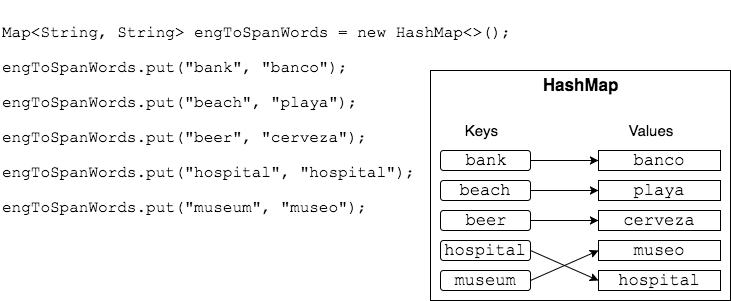
-
Finding an object by a unique piece of data.

Fast Lookup
Finding values in a Map is very fast.
Consider searching an unordered List<String> for a value.
* We would have to start at the beginning and call .equals() on each element's identifying field (or the element itself).
* The worst case is when the element is last in the List.
* If there are n items in the List, we would do n .equals() comparisons.
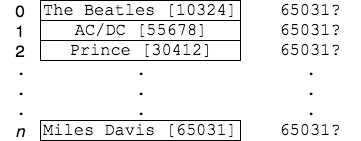
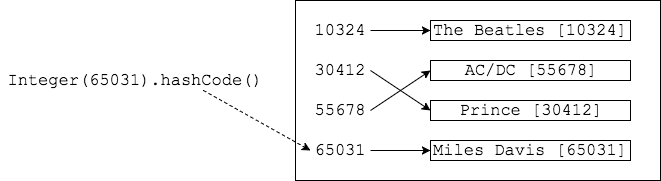
With a Map, we simply provide the key, and are given the value.
* The Map can find the key using the key's hashCode() and simple math operations, so it is much faster than searching a List.
Practice Exercise
Computer scientists call this worst-case evaluation of how long an algorithm takes Big O Notation (Big "Oh" Notation).
Big O is represented as a mathematical function, O(value).
Big O is not a measure of actual time (like nanoseconds), but how many times an algorithm has to do a set of operations relative to the size of a data set.
O(1) describes an algorithm that will always take the same amount of time, regardless of input data size. *
HashMap'sgetandputmethods provide this.O(n) describes an algorithm whose time to execute will grow linearly and in direct proportion to the size of the input data. * Searching an unordered
Listrequires, worst-case, n comparisons, so we say it is O(n).Searching using a nested
forloop would be O(n) * O(n), or O(n2).